
Operations and supply chain roles increasingly demand graduates who can work inside messy systems. New hires are expected to analyze unstable processes, interpret incomplete data, and engage frontline stakeholders in real time. Traditional lecture-heavy courses and textbook cases teach concepts well, but they often fall short in developing applied capabilities, such as lean waste identification, current-state mapping, and implementation-focused problem-solving. In a recent operations management course, students who worked inside a live operating facility reported markedly stronger applied learning outcomes than peers who completed traditional textbook case projects. As shown in Table 1, students participating in industry-based projects reported meaningfully stronger applied capabilities than those completing textbook cases. Gains were largest in applying operations methods and lean thinking, with improvements of roughly 10% to 14%. Differences in higher-level conceptual understanding, such as operations strategy, were present but more modest.
Table 1: Learning domain in different project formats
|
Learning domain |
Industry-based project |
Textbook case project |
Improvement with industry-based project |
|
Application of methods |
4.02 |
3.52 |
+14% |
|
Lean thinking |
3.58 |
3.24 |
+10% |
|
Process understanding |
3.63 |
3.33 |
+9% |
|
Operations strategy |
3.73 |
3.5 |
+7% |
Note. Mean post-course scores (1–5 scale) based on the author’s course data.
Immersive learning offers a way to close this gap. Rather than simulating reality, immersive projects place students directly inside operating systems where ambiguity and judgment are unavoidable. Drawing on an immersive engagement model implemented in an undergraduate operations and supply chain management (OSCM) course, this article demonstrates that repeated engagement with a live facility function not only serves as teaching but also as early-stage training for real-world supply chain work.
Why immersive projects matter
Applied capabilities develop most strongly when learners work in authentic settings and repeatedly test assumptions against reality (Kolb, 2015). To examine what this looks like in practice, a 3000-level OSCM course at a Midwestern university employed two project formats in parallel. Two sections (n=70) completed structured textbook case projects, while one section (n=29) completed an industry-based immersive project with a regional material recovery facility (MRF). The study is consistent with prior research in operations and supply chain education that compares case-based and experiential formats (Heriot et al., 2008; Kang et al., 2010). All sections shared the same instructor, lectures, and assessments.
From classroom project to immersive engagement
The immersive project was intentionally designed to move beyond a traditional classroom assignment and function as a structured, real-system engagement. The course partnered with a privately operated material recovery facility, which provided a complex, high-variability operating environment, making it well-suited to applied learning in operations and supply chain management. Students were positioned as novice analysts rather than problem solvers. They were not asked to redesign processes or implement solutions, but to observe work as it actually occurred, verify assumptions with frontline employees and line managers, and document current-state processes. This design choice shifted the project from a one-time course exercise to an immersive experience that mirrors how early-career professionals learn to understand and diagnose real operational systems.
Inside the four-visit immersive model
The immersive project embedded students directly in a high-variability, sustainability-oriented operating environment. Students were organized into four teams, each assigned to a specific production line for the duration of the project. The engagement followed a repeatable, worksheet-driven cycle across four site visits.
Visit 1 – Orientation and scoping. Students completed safety training, toured the facility, and observed all production lines, clarifying project scope and initial task constraints with line managers.
Visit 2 – First-pass mapping and data capture. Teams observed their assigned line, documented task steps, equipment use, handoffs, and visible wastes, and sketched initial current-state maps using structured worksheets.
Visit 3 – Refinement and validation. Students returned with revised maps, conducted targeted observations, and validated assumptions with line managers and operators. Each visit ended with a simple check: “Is this what really happens on your line?”
Visit 4 – Final validation and synthesis. Teams reviewed near-final maps with facility staff, corrected inaccuracies, and synthesized findings into a final report and presentation.
At the end of the semester, the community partner attended in-class presentations, heard student recommendations, and provided feedback and clarifications. This closed the loop between student learning and organizational value.
What changed in student learning?
Learning outcomes were assessed using voluntary pre- and post-course surveys aligned with course objectives. Four domains were measured on a five-point scale: operations strategy understanding, process understanding, lean thinking, and application of methods.
Pre-course results indicated similar baseline levels across sections, suggesting comparable starting points. Post-course results, however, revealed clear differences by project format. Students in the industry-based immersive project reported higher mean scores across all four domains than students in textbook-based projects. The largest differences appeared in applied domains.
Figure 1: Post-course learning outcomes by project format (mean scores)
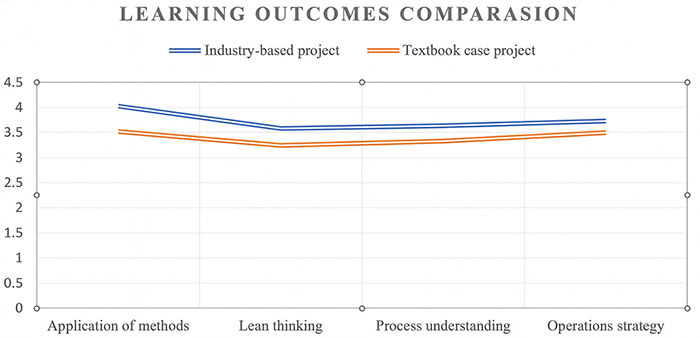
The largest gains appeared in applied domains such as lean thinking and application of methods, while improvements in higher-level conceptual understanding were smaller, a pattern commonly observed in experiential operations and supply chain education (Al-Shammari, 2022; Yazici, 2020). Regression analyses controlling for year of study, prior operations coursework, work experience, and familiarity with operations confirmed that project format remained a significant predictor of post-course outcomes across domains.
In practical terms, students who worked inside a real system felt more confident identifying waste, applying lean tools, and interpreting operational tradeoffs than peers who worked exclusively with cases. From an employer perspective, these gains translate into faster onboarding and earlier contribution in improvement and operations roles.
What the numbers mean in practice
The pattern aligns closely with experiential learning theory. The immersive project exposed students to real process variability and incomplete data; repeated cycles of observation, mapping, verification, and revision; direct interaction with line managers and operators; and responsibility for presenting feasible improvement ideas. The importance of these conditions has been consistently noted in experiential and project-based operations education (Heriot et al., 2008; Miyaoka et al., 2018). The stronger gains in lean thinking and application of methods suggest that students learned not only what lean is, but also how to use it in real systems.
Why this functions as training, not just teaching
The MRF presented a highly variable context characterized by contamination, equipment downtime, and staffing constraints. Students confronted the same ambiguity and noise that characterize real operations. Further, the four-visit structure, paired with worksheets and explicit expectations for verification and revision, mirrored the iterative nature of improvement and consulting work. Students worked alongside line managers and employees to develop current-state maps and waste analyses, and then presented the findings to those stakeholders. Additionally, these dynamic parallels early career roles, where credibility must be earned through engagement rather than authority. Immersion most strongly affected applied capabilities, while conceptual strategy knowledge improved more modestly, consistent with prior findings that case-based approaches support conceptual understanding, while immersive projects develop judgment and application skills (Kang et al., 2010; Yazici, 2020).
Implications for universities and industry partners
The immersive training is beneficial for both educators and companies (Table 2). For educators, immersive, industry-embedded projects demonstrate that applied capabilities can be developed and assessed systematically through structured, repeated engagement rather than one-off experiences. For companies, the same model provides a low-risk way to surface operational issues, gain current-state insight, and engage with potential hires without committing to a full consulting or improvement program.
Table 2: Value of Immersive, Industry-Embedded Projects
|
Primary Value |
Educators |
Companies |
|
Applied skills |
Lean thinking, process mapping, real-system problem solving |
Job-ready analysis and communication skills |
|
Insight |
Measurable learning outcomes |
Fresh visibility into everyday operational issues |
|
Engagement |
Structured, repeatable course design |
Low-risk, diagnostic-only involvement |
|
Readiness |
Graduates are prepared for messy systems |
Faster onboarding, earlier contribution |
Final wrap up
Immersive learning prepares students for the reality they will face on day one: real systems, real people, and real constraints. Evidence from this engagement indicates that students who worked in a live operating environment developed stronger applied capabilities than peers who relied on textbook cases. For supply chain leaders and educators alike, immersive projects offer a practical means of aligning education with workforce needs. When carefully designed, they function not only as teaching tools but also as early-stage training for the next generation of supply chain professionals.
About the author
Corrine Chen is an educator, researcher, and former industry executive with over a decade of hands-on experience in supply chain management, procurement, and innovation. She teaches supply chain management courses at the University of Nebraska Omaha. Corrine’s work bridges academia and practice through published research, applied projects, and a commitment to empowering the next generation of supply chain professionals. She can be reached at [email protected].
References
Al-Shammari, M. M. (2022). An exploratory study of experiential learning in teaching a supply chain management course in an emerging market economy. Journal of International Education in Business, 15(2), 184–201. https://doi.org/10.1108/JIEB-09-2020-0074
Heriot, K. C., Cook, R., Jones, R. C., & Simpson, L. (2008). The use of student consulting projects as an active learning pedagogy: A case study in a production/operations management course. Decision Sciences Journal of Innovative Education, 6(2), 463–481. https://doi.org/10.1111/j.1540-4609.2008.00186.x
Kang, R., Yang, J., & Wei, J. (2010). Engaging undergraduate business students in experiential learning through a required term project in an operations management course. Educational Research, 1(4), 99–111.
Kolb, D. A. (2015). Experiential learning: Experience as the source of learning and development (2nd ed.). Pearson Education.
Miyaoka, J., Ozsen, L., Zhao, Y., & Cholette, S. (2018). Experiential undergraduate operations management course engages students. Journal of Supply Chain and Operations Management, 16(3), 219–247.
Yazici, H. J. (2020). Project-based learning for teaching business analytics. Decision Sciences Journal of Innovative Education, 18(4), 589–611. https://doi.org/10.1111/dsji.12219
SC
MR


More Talent Development
- Developing the next generation of supply chain leaders: Is higher education serving the needs of the marketplace?
- The value proposition: Bridging the skills gap between the SCM degree and the workplace
- Developing supply chain talent for new product development
- America wants to reshore manufacturing—but who will do the work?
- Training in the real system: How immersive projects prepare the next generation of supply chain professionals
- More Talent Development
What's Related in Talent Development
 Explore
Topics
Business Management News
- Why companies blame the wrong supplier … and miss the real failure
- NextGen Supply Chain Conference unveils agenda focused on AI, execution and the future of leadership
- Supply chain resilience isn’t a data problem; it’s a judgment problem
- Beyond the hype: Building flexible and scalable supply chains in a VUCA world
- Why your supply chain risk management plan will fail
- What options do you really have? Shaping the supply chain resilience funnel
- More Business Management
Latest Business Management Resources
Subscribe

Supply Chain Management Review delivers the best industry content.

Editors’ Picks



